
Hospitality
Making room for the forgotten virtue

Hospitality feels like one of those things everyone agrees is important but no one is quite sure how to do anymore.
It used to be simpler. And more assumed. You lived closer to people, literally and otherwise. You borrowed things. You knew who was around. You had a sense, even loosely, of who might need help and who might offer it. People were more in one another’s way.
The world we live in now is much better at boundaries. We schedule carefully. We plan exits before we arrive. We like knowing how long something will last and what’s expected of us while we’re there. We want mass to be one hour and not a minute more. We check the runtime of movies before we commit. We ask what time dinner ends. We rehearse polite excuses in our heads just in case.
We don’t mean to shut anyone out. We’re just trying to hold our own plans together.
But the virtue of hospitality doesn’t cooperate with that. It doesn’t ask what time you need to leave and it tends to show up right when you were planning your own quiet exit.
You can see the absence of this virtue most sharply around the holidays. Togetherness is everywhere, but hospitality, the kind that makes room for the unexpected person, feels harder to find. You’re either part of the plan or you’re not. And the people who aren’t start to become visible in a way that feels almost too bright.
Church is where this visibility becomes unavoidable.
There are people who come alone every week. More than you’d think. They sit carefully, usually in the same place and don’t draw attention to themselves. Sometimes they leave as soon as Mass ends. Sometimes they stay just long enough that you wonder if they’re waiting for a reason to linger. The part that hurts me the most is that they’re trying. They could stay home. That would be easier. But they come anyway.
I learned how to manage the discomfort of this by telling myself their families probably understood them better. That their friends would notice. That it wasn’t really my place, and that stepping in might make things awkward. I got good at being polite about it. And distant. Which I now understand is a very effective way to feel concerned without having to change anything at all.
I wonder how many of us do the same.
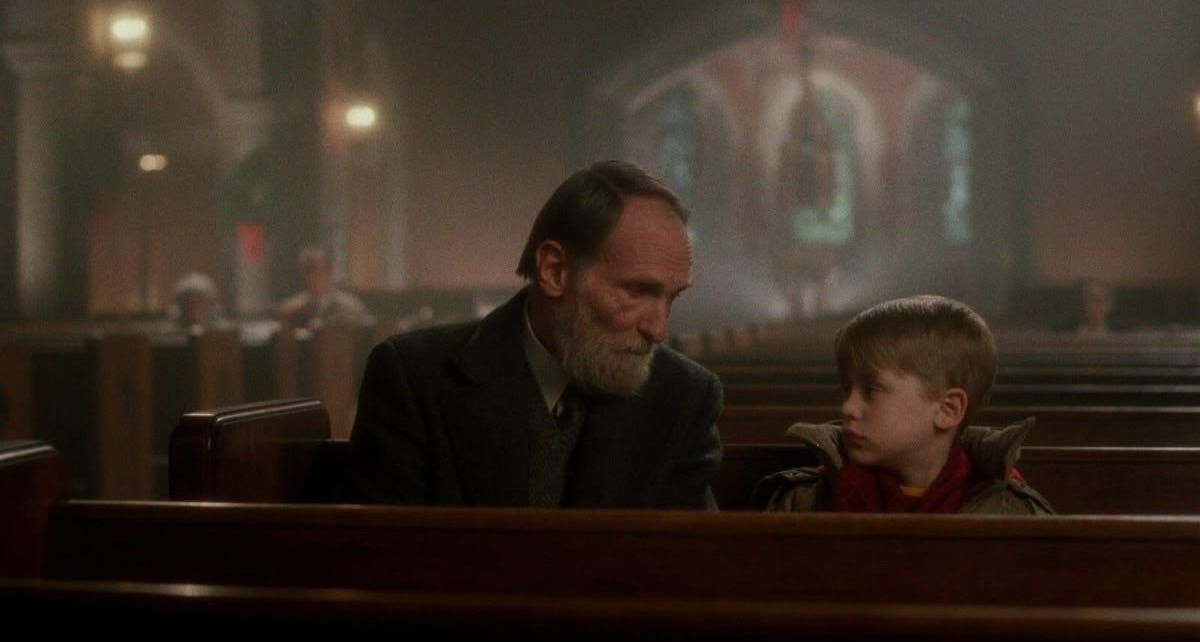
In college, my involvement in campus ministry quickly got rid of that standoffish disposition. You start to see how many people are waiting—not in an obvious way, not with their hands raised, but simply by continuing to show up. They come back, week after week, as if something might eventually meet them there. On a college campus, that often looks like students arriving alone—to Mass, to events, to rooms that are full but still somehow leave space around them.
So I paid closer attention. I noticed what pew people sat in. Who slipped out right away and who lingered like they were waiting for a reason not to leave yet. I realized that there was almost always some common ground I could find with someone, whether that be classes we shared, sports, music, a movie, or the simple fact that we were both there.
I didn’t always have an invitation ready. Sometimes I’d walk toward someone and realize halfway there that I had absolutely no idea what I was going to say. I had many awkward moments trying to reach out to people.
But it didn’t matter. And I think this is the part we tend to miss. The exchange is wildly uneven. For you, it’s a few seconds of discomfort—a pause that stretches a beat too long, a sentence that comes out slightly wrong, that small flash of embarrassment that passes almost immediately. And then your day continues more or less unchanged.
For the person standing there alone, it can mean something else entirely. It can change how the rest of the week feels. Or whether they come back at all. It can be the difference between leaving right away and staying, between feeling invisible and feeling noticed. Hospitality doesn’t ask for very much, but it gives back far more than you think. And once you see that imbalance clearly, it becomes hard not to keep trying.
I don’t mean any of this to sound like I’m especially good at it. I’m not some saint for talking to people. It’s something I just think is important enough to do. And you should too. It’s a shared responsibility we’ve mostly forgotten how to carry together.
I think the idea of hospitality feels intimidating for people because we imagine it has to be big. That it means inviting everyone to your Christmas dinner or becoming someone’s entire social life. That once you notice loneliness, you’re singlehandedly responsible for fixing it.
But you don’t need to be everything to anyone. You don’t need to become everyone’s friend, or their anchor, or the person they relied on forever.
It’s much smaller than that. Sometimes it does mean bringing someone into your own circle. But more often, it means plugging them into someone else’s—people who will get them better, laugh with them more easily, meet them where they actually are.
Oh, you love that band? You should talk to my friend who’s obsessed with them. You’re new here? I know someone who just moved too—I’ll text you both. Sometimes it’s literally just exchanging phone numbers and stepping back.
That’s it.
We underestimate how much that matters because it feels so ordinary. But ordinary is exactly the point. You’re not saving anyone. You’re connecting them. You’re letting the community do what it’s meant to do.
And once you do that, your role is finished. You don’t need to hover. You don’t need to follow up obsessively. You don’t need to become the center of the story. The most generous thing you can do is let other people take over.
Hospitality requires trusting that other people are capable of kindness too. That the world doesn’t rest on your shoulders. That you’re allowed to be a bridge and then move out of the way.
This is part of why it’s so beautiful. And why it’s so doable. It asks for attention, not perfection. Willingness, not performance. A few seconds of awkwardness in exchange for the possibility that someone won’t feel quite so alone.
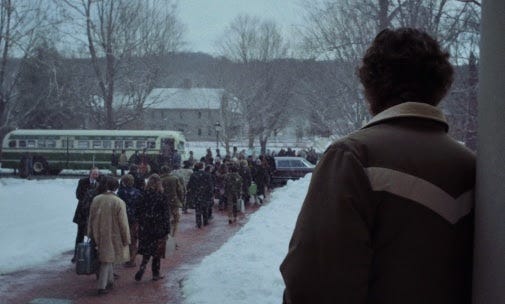
No human being is ever merely “one among many.” We are tempted to think so, of course, because it makes life more manageable. But Christianity will not allow us that comfort. If one person is missing, something real is missing. A body does not remain whole simply because most of its parts still function. A numbed hand or an injured rib is not insignificant just because the rest of the body manages to get on with its business.
We say Mystical Body of Christ and it can sound like a stained-glass phrase until you watch it in real time: one person hovering at the edge, one person leaving early, one person whom Christ loved enough to die for trying so hard to look untroubled about being alone. That’s when you realize this isn’t a sweet extracurricular. This is the whole point.
The Church, after all, is not an audience assembled to observe something interesting. It is a body joined to its Head. And this means that what we are inclined to dismiss as small actions are not small at all. A word, an invitation, a simple act of attention may be the very means by which the body begins to heal where it has been wounded.
The Church seems to understand this even when we forget. All the coffee and donuts, the dinners, the events that can feel a little unnecessary or corny—the events were never the point. They’re simply the means of keeping people around long enough for something human to happen. For someone to recognize a face. For a conversation to begin. For a person who arrived alone to stop feeling like they have to leave that way.
On a college campus, this is built in. Everyone is moving through the same places at the same times. You see the same people again and again and community has a chance to form almost accidentally.
But, at some point, that structure disappears. You graduate. You move. Life scatters. And suddenly nothing is automatic anymore. For most people, it can start to feel like real community was something they were allowed once, briefly, and then outgrew.
But I don’t think that’s actually true.
It is possible. It’s within reach for you. Community doesn’t require a campus or a program or a perfectly organized calendar. It just requires someone to act as if community is still possible. As if people still want to belong. As if it’s worth the effort to go first.
I don’t know exactly what that will look like for me now, without the structure I have been used to for so long on campus. But I know what it feels like when it works. I know how real it can be. And I know how different the world starts to look when people stop assuming connection is someone else’s responsibility.
Hospitality is how these worlds get built one invitation at a time.
And once you’ve seen it happen, it’s hard not to believe it could happen again.

We are often tempted to imagine that God works best when our lives are orderly. But God’s purposes have a habit of arriving unannounced, of asking for room precisely when we believe we have none to spare. Bethlehem was full. Every door had a reason to stay closed. And yet history turned on the one place that allowed itself to be interrupted.
The danger, then, is not that we are wicked or unkind, but that we are too occupied with our own designs to leave space for God’s. We protect our plans so carefully that there is no margin left for the stranger, no room for the unexpected claim, no patience for the person who does not fit neatly into our arrangements. And in doing so, we may close the very door through which grace intends to enter.
Christian hospitality is not chiefly about generosity of resources, but generosity of attention. It is the willingness to let other lives press upon ours, to allow the community to bump into our plans rather than be excluded by them. To make room, even when it is inconvenient. Especially then.
For the God we worship does not come only in the familiar and the welcome. He comes as Mary and Joseph, as the unplanned guest, as the lonely person at the edge of the room. And the question He asks is not whether we are busy, but whether we have made any space at all.
At Christmas, and always, the invitation is the same: do not be so consumed by your own agenda that you have no room left for God’s.
I love the idea of paying attention to who is clearly lingering hoping for more. Speaking from experience, there are absolutely times that those who come alone want to leave alone and it shows. Honoring that is also hospitable. Noticing when that attitude is absent opens the door for the kind of connection we are created for
Wow. This is so so profound. This has been on my mind lately, especially within the Church. Thank you for sharing!